Showing posts with label Camino de Santiago. Show all posts

Tuesday, May 26, 2020

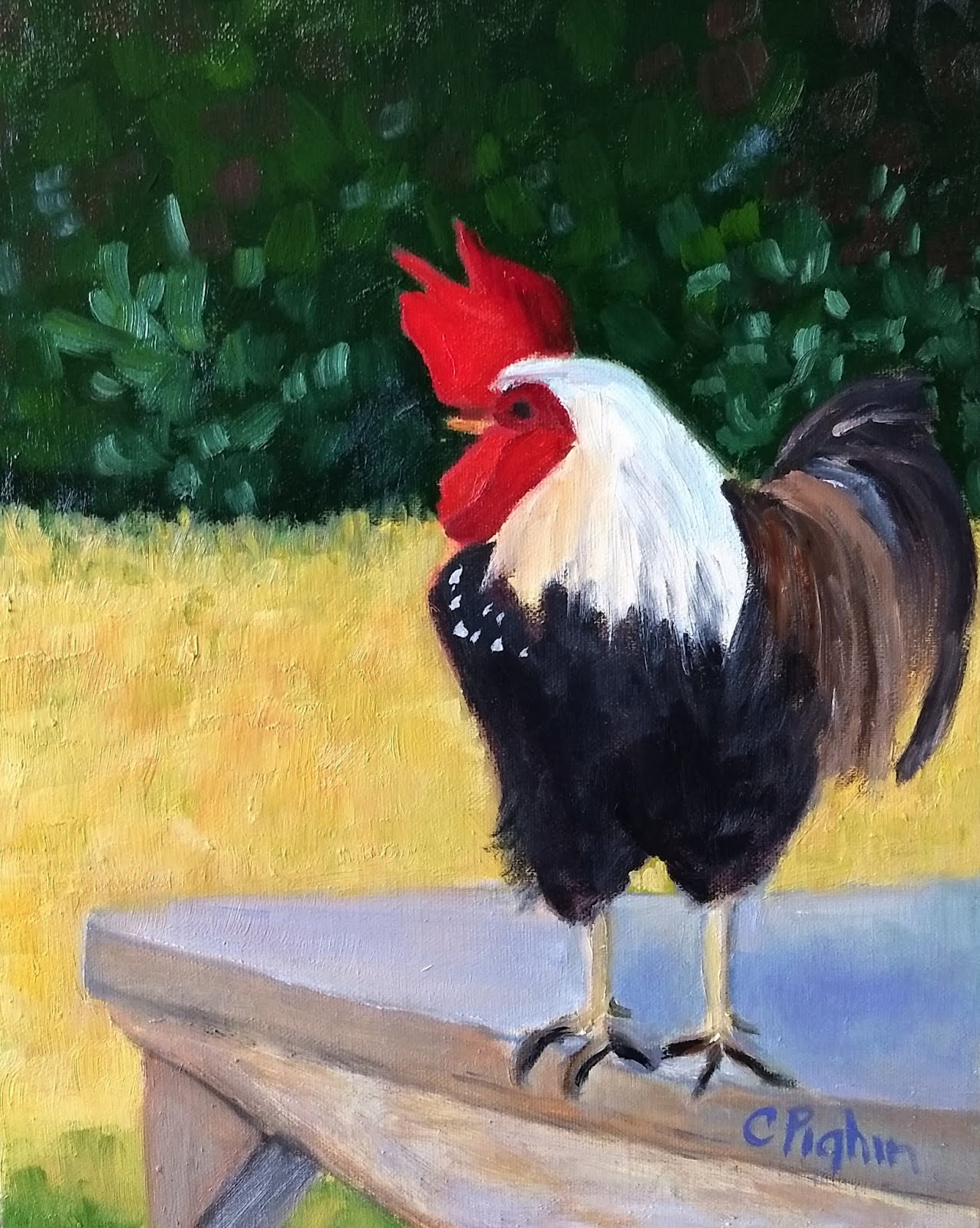
"Camino Rooster"


More fun in voting for one of my paintings again.  This is for Bold Brush competition.

https://faso.com/boldbrush/painting/212187 Click on the link and vote for my "Camino Rooster".

Monday, February 17, 2020

"Camino Rooster"


"Camino Rooster"
10" x 8"
Oil on linen panel
available

Almost six years ago, I saw this rooster posing while my husband and I were walking through Spain.
It was a wonderful journey walking 150 miles of the Camino de Santiago.  I still have lots of images from walking "The Way" to paint.

Friday, March 30, 2018

Country Walk


"Country Walk"
30" x 30"
oil on gallery wrapped canvas
This inspiration for this painting came from a photo I took while walking the Camino de Santiago in Spain.  The views along the way were gorgeous.  We walked through countrysides, vineyards, villages centuries old. and thriving cities. 

Monday, February 26, 2018

Day 26 "Hill Top Vineyard"


Day 26 
"Hill Top Vineyard"
8" x 10"
oil on canvas panel
This image I took while walking the Camino de Santiago in Spain.  This was the second day and we only ran into one other person.  Such a beautiful treat to feel like the whole vineyard was yours to enjoy.

Tuesday, February 6, 2018

Day 6 "Country Walk"


Day 6  ~ 30 paintings in 30 days
Second 30 challenge
5" x 7"
oil on linen panel
On auction at Daily Paintworks
click below
https://www.dailypaintworks.com/artists/carol-pighin-5435/artwork

Monday, February 5, 2018

Day 5 "Sunny Morn II"

Day 5 of 30 paintings in 30 Days with Leslie Saeta
Sunny Morn II
8" x 10"
oil on canvas
Today is the same image as yesterday but a more delicate palette.

Monday, September 26, 2016

Day 26 "Symbols"


30 Paintings in 30 Days
Day 26
Symbols
7" x 5"
Oil on canvas panel

Various markers lead the way to Santiago de Compostela.  This ancient stone marker is filled with symbols.  On the left in blue is the scallop which is always found to mark the way to the church of St. James.  The cross is the symbol of St. James.  The "Stones of Sorrow" are placed on the marker.  Some bring them from home or like me, I would pick up one and carry to one of the special places that we stopped.

Tuesday, January 26, 2016

Day 26 "Casa de España"


30 Paintings in 30 Days
Day 26
"Casa de Espana"
20" x 24"
oil on canvas

I started this painting in Connie Winters workshop yesterday.  If I was to paint it again, I would take longer to finish it.  This is a painting a day so I am posting a painting everyday.  This painting was after a photo that I took on the Camino de Santiago.  The town was called Ambasmestas.  In Spain this color of blue was used often on doors and windows.

Sunday, April 12, 2015

Getting ready for "Big Saturday"

"Village Path"
18" x 20" with frame
$225

"Hay Bales I"
21" x 23 1/2" with frame
$225

Two more paintings ready to take to Charlotte Country Day's "Big Saturday", on April 18th.
These two paintings are from my Camino de Santiago series of scenes that I saw while walking in Spain.
30% of sales go to Charlotte Country Day School.
Come to Cannon Library April 16, 17 & 18.


Sunday, October 12, 2014

"The Way of St. James"


For a thousand years pilgrims (peregrinos) have been walking the Camino de Santiago in Spain.  Santiago de Compostela is where the apostle James remains are buried.  The Pilgrimage starts in France in the Pyrenees and continues 500 miles through Northern Spain.

My husband and I decided to walk 150 miles of the Camino.  The 150 miles took twelve days with one day of rest, an average of 13 miles per day.  It was on the third day of the trip after walking nine miles uphill, that I realized I could do the whole 150 miles.  At the end of some days it was pure determination that kept me putting one foot in front of another.

The beauty of the scenery was breathtaking.  I kept thinking of the saying “It is the journey not the destination”.  I tried to stay in the moment and enjoy each mile.   There were countless villages, churches, monasteries, ancient hospitals and hostels (albergues) along the way. Many of these sprang up in the middle ages for the sole purpose of taking care of the hundreds of thousands of pilgrims that traveled every year.

Upon reaching Santiago de Compostela, Wayne and I stood in line receive our certificate of completing for walking at least 100 km of the Camino.  It was a very proud moment for us.
The next day we entered the cathedral and felt the enormity of the walk.  I was overwhelmed with emotion.  We were part of the pilgrim community.  We were strangers walking with the same goal. We had wished each other Buen Camino as we walked toward Santiago de Compostela.  We were finally there to visit the remains of St. James.  The cathedral was beautiful and full of other pilgrims feeling this same emotion.  

The Camino de Santiago is an experience that is different for everyone.  The best way to walk the Camino is up to the individual.  There are many choices of where to start the journey, where to stay, whether to walk alone, with a friend, or with a group.  If I was tired, had sore feet, or the sun beating down on my back, I enjoyed each step of "The Way".


Saturday, October 4, 2014

"Grape Arbor on the Camino"

"Grape Arbor on the Camino"
10" x 8"
oil on gallery wrapped canvas
$150
September 6, 2014
This day's walk was from Arzua to Pedrouzo about 12 miles.  It was a beautiful early walk with the morning mist and the sun warming the grape arbors as we walked through them.  This  part of the Camino was filled with picturesque farms and eucalyptus tree forests.

Tuesday, September 16, 2014

"Walking the Camino de Santiago" August 27 to September 7, 2014


My husband and I walked 150 miles from Ponferrada to Santiago de Compostella.
The shell represents the peregrinos (pilgrims) who over centuries have walked this path to get to Santiago.  The whole pilgrimage is about 500 hundred miles.  People walk all of it of part or it like we did.
The middle photo of the shell is the original that was found underneath part of the church in the 12th century.  Shells were given to the peregrinos when they arrived at their destination.  The shells are the way-markers that  lead you to Santiago de Compostella.  This photo is a collage of some of the way-makers that we encountered along the way.  Now pilgrims buy the shells (conchas) and put it on their backpacks as they walk all those miles.

Labels